PREMIER BENCH PRESS
An intelligent bench press assistance system using computer vision for real-time movement correction
This project presents a modern bench press assistance system that integrates computer vision and intelligent mechanical support to enhance safety, performance, and execution quality. Using real-time visual analysis, the system detects lifting posture, bar path, and movement deviations, providing immediate execution correction and objective performance feedback. The assistive mechanism is designed to adapt dynamically to the user’s motion, reducing injury risk while enabling precise biomechanical analysis. This platform demonstrates the potential of combining artificial intelligence, vision-based motion tracking, and mechanical design to redefine strength training through smart, data-driven assistance.
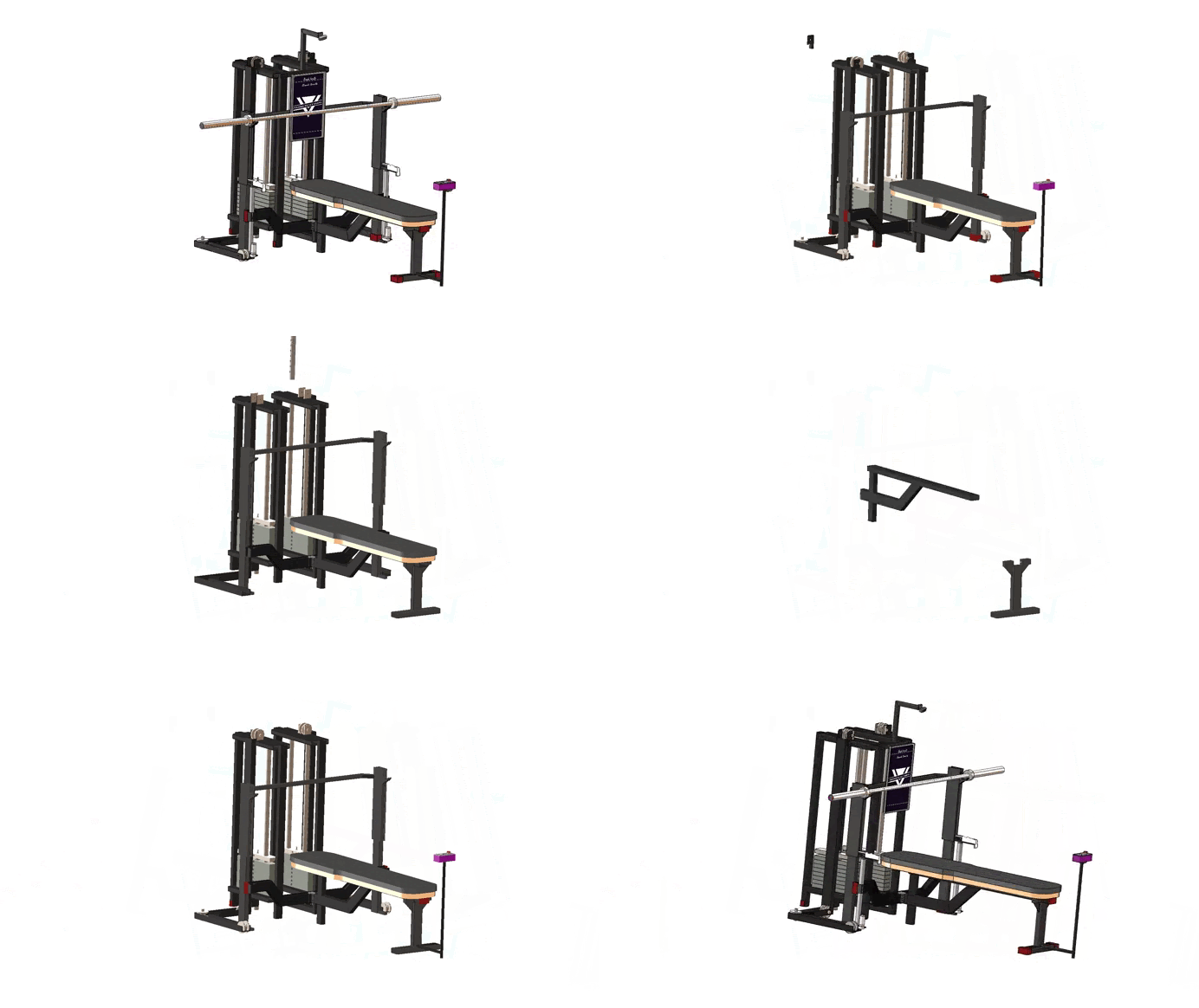

Summary of the Intelligent Bench Press Assistance System
Embedded Control Module (Low-Level System):
The system incorporates a dedicated embedded microcontroller responsible for real-time control of actuators, sensors, and safety mechanisms within the bench press assistance structure. This module ensures precise force modulation, synchronized motion, and immediate response to user interaction, managing parameters such as assistive load, bar stabilization, and emergency intervention with minimal latency.
High-Level Processing Unit:
A Raspberry Pi 5 serves as the main computational unit, handling advanced computer vision, signal processing, and execution analysis. It processes visual data captured from cameras to extract kinematic features such as bar trajectory, joint alignment, velocity profiles, and symmetry, enabling intelligent interpretation of the lifting motion and detection of execution deviations.
System Integration and Control Architecture:
The architecture integrates low-level embedded control with high-level vision-based intelligence through a hierarchical control framework. The microcontroller executes deterministic control tasks, while the Raspberry Pi 5 performs data-driven analysis and decision-making, communicating corrective commands and assistive adjustments through optimized control loops.
Execution Correction and Assistive Intelligence:
Using real-time computer vision algorithms, the system identifies improper movement patterns, asymmetries, or biomechanical inefficiencies during the bench press exercise. Based on this analysis, the assistive mechanism dynamically adjusts support levels and provides corrective feedback, enhancing lifting accuracy, reducing injury risk, and improving overall performance consistency.
Modularity, Scalability, and Future Expansion:
The system is designed with a modular hardware and software architecture, allowing seamless integration of additional sensors, improved AI models, or enhanced mechanical components. This flexibility ensures scalability toward more advanced biomechanical analysis, adaptive learning algorithms, and broader applications in intelligent strength training and rehabilitation systems.


Clinical and BiomechanicalValidation
of the System
The system is supported by clinical and biomechanical analysis, ensuring that its design and corrective strategies are aligned with established principles of human movement and injury prevention. The assistive and vision-based correction mechanisms are validated through controlled laboratory evaluations, comparing kinematic data, execution patterns, and load distribution to clinically accepted benchmarks. This clinical-oriented analysis reinforces the system’s reliability, safety, and applicability for both performance optimization and injury risk reduction.